
Estimate a project
accurately
Project estimation is one of the most critical steps in project management. It directly impacts planning, budgeting, resource allocation, and ultimately, the success of your project.
Yet inaccurate project estimates remain one of the most common mistakes, even among experienced teams. Missed deadlines, budget overruns, overworked employees, and dissatisfied clients are just some of the consequences.
So, how can you estimate a project accurately and avoid the most common pitfalls? Here are the methods and best practices that will help you improve the accuracy of your project estimates.

Why project estimation is so difficult?
Estimating a project isn’t simply about “coming up with a number.” It’s a complex process influenced by several factors.
Uncertainty is inevitable
Every project involves unknowns, including:
- Technical complexity
- External dependencies
- Unexpected issues
- Changing requirements
Even experienced teams cannot anticipate everything.
A natural optimism bias
Teams often underestimate:
- The time required
- The complexity of tasks
- Unexpected challenges
This cognitive bias, known as the optimism bias, often leads to overly optimistic estimates.

Lack of historical data
Without reliable historical data, estimates are often based on assumptions rather than facts.
The result? Significant gaps between planned and actual outcomes.
The most common estimation mistakes to avoid
Estimating too quickly
A rough estimate made without careful analysis is rarely accurate. Reliable estimates require time and a structured approach.
Failing to break down the work
Estimating an entire project as one large task almost always results in inaccurate figures. The more detailed a task is, the easier it becomes to estimate.
Ignoring unexpected events
Unexpected issues are part of every project, such as:
- Software bugs
- Client feedback
- Changing priorities
- Technical dependencies
Ignoring them almost guarantees underestimated timelines.

Excluding the team
The people who perform the work are best positioned to estimate it. A collaborative estimation process is generally far more reliable than a purely top-down approach.
Never revisiting the estimate
A project estimate shouldn’t be set in stone. It should evolve as the project progresses and new information becomes available.
Steps to estimate a project effectively
Clearly define the scope
Before estimating anything, clearly identify:
- Project objectives
- Expected deliverables
- Constraints
- What’s out of scope
An unclear scope inevitably leads to unreliable estimates.
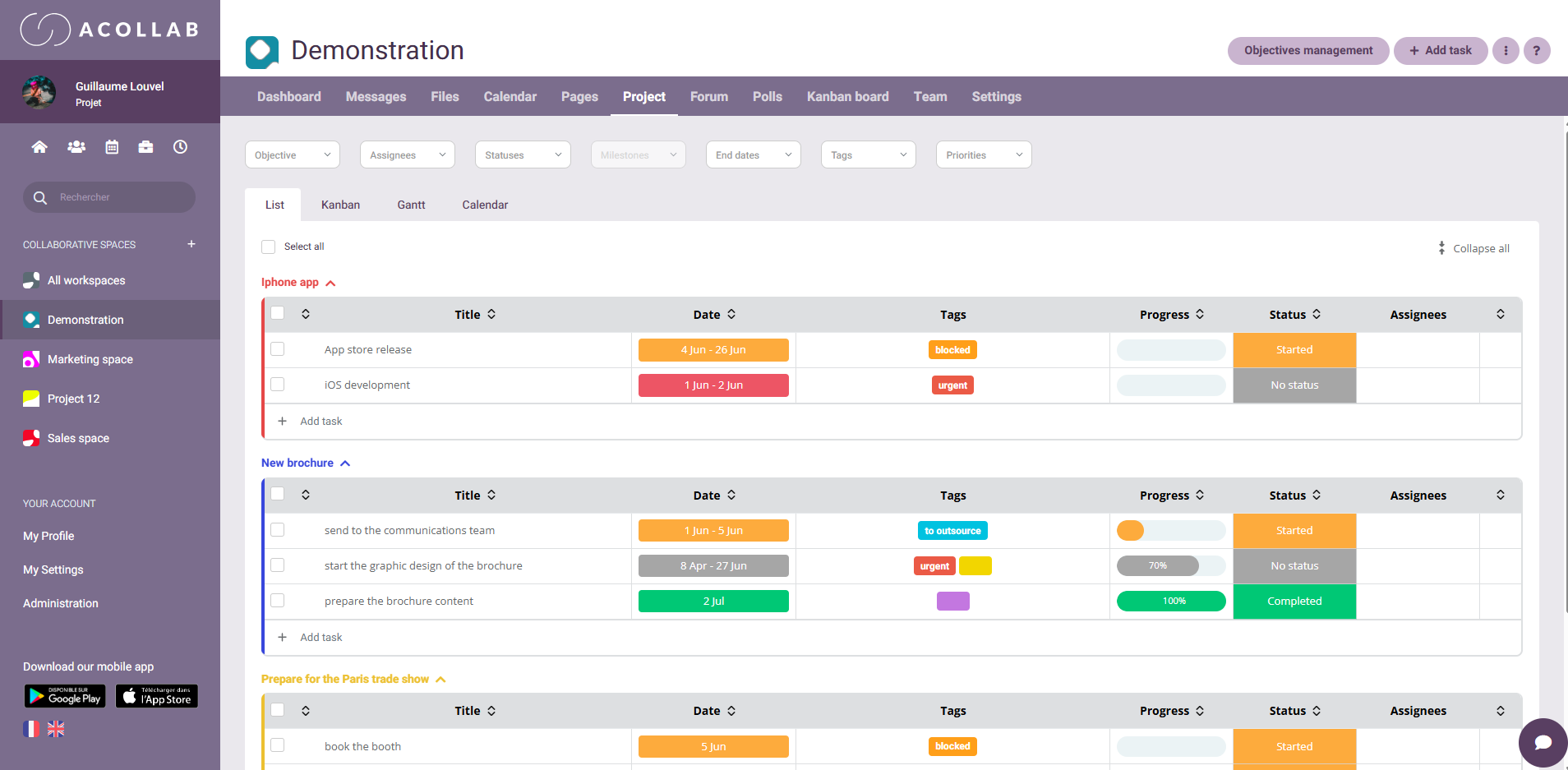
Break the project into tasks
Divide the project into:
- Phases
- Subtasks
- Concrete actions
The more detailed the breakdown, the more accurate the estimate.
Estimate each task individually
Each task should be estimated independently.
This helps you:
- Identify complex areas
- Reduce the risk of omissions
- Improve overall accuracy
Add a safety buffer
An estimate without contingency is a risky estimate. You should include either:
- An overall project buffer
- Or individual buffers for critical tasks
This allows you to absorb unexpected events without jeopardizing the project.
Validate estimates as a team
Involving the entire team helps to:
- Compare perspectives
- Identify inconsistencies
- Improve estimate accuracy
The result is a more realistic estimate that everyone supports.

The most effective project estimation methods
Analogous estimation
This method uses similar past projects as references. If you use a time tracking tool, you can easily find the time spent on similar tasks.
Example: “This project is similar to the one we completed last year, which took 20 days.”
Advantages :
- Fast
- Experience-based
Limitations :
- Depends on the quality of historical data.
Three-point estimation
This technique considers three scenarios:
- Optimistic
- Most likely
- Pessimistic
A weighted average is then calculated. This approach better accounts for uncertainty.
Planning Poker
A collaborative estimation technique widely used in Agile teams. Each team member independently estimates the work before discussing the results together.
It helps to:
- Compare viewpoints
- Reduce individual bias
- Produce more balanced estimates

Bottom-up estimation
Each individual task is estimated separately before the totals are added together. Although this method is the most time-consuming, it is also the most accurate.
Why historical data matters
Reliable estimates are built on real-world data. To continuously improve your estimates, you should:
- Keep a history of completed projects
- Compare estimated and actual durations
- Analyze the differences
Historical data helps teams become increasingly accurate over time.
How project management software improves estimation
Project management software plays a key role in improving estimate accuracy. It helps structure tasks, monitor project progress, and compare forecasts with actual results.
This is exactly the approach offered by Acollab, which enables teams to break projects down into detailed, structured tasks complete with priorities, assignees, deadlines, and other essential information.
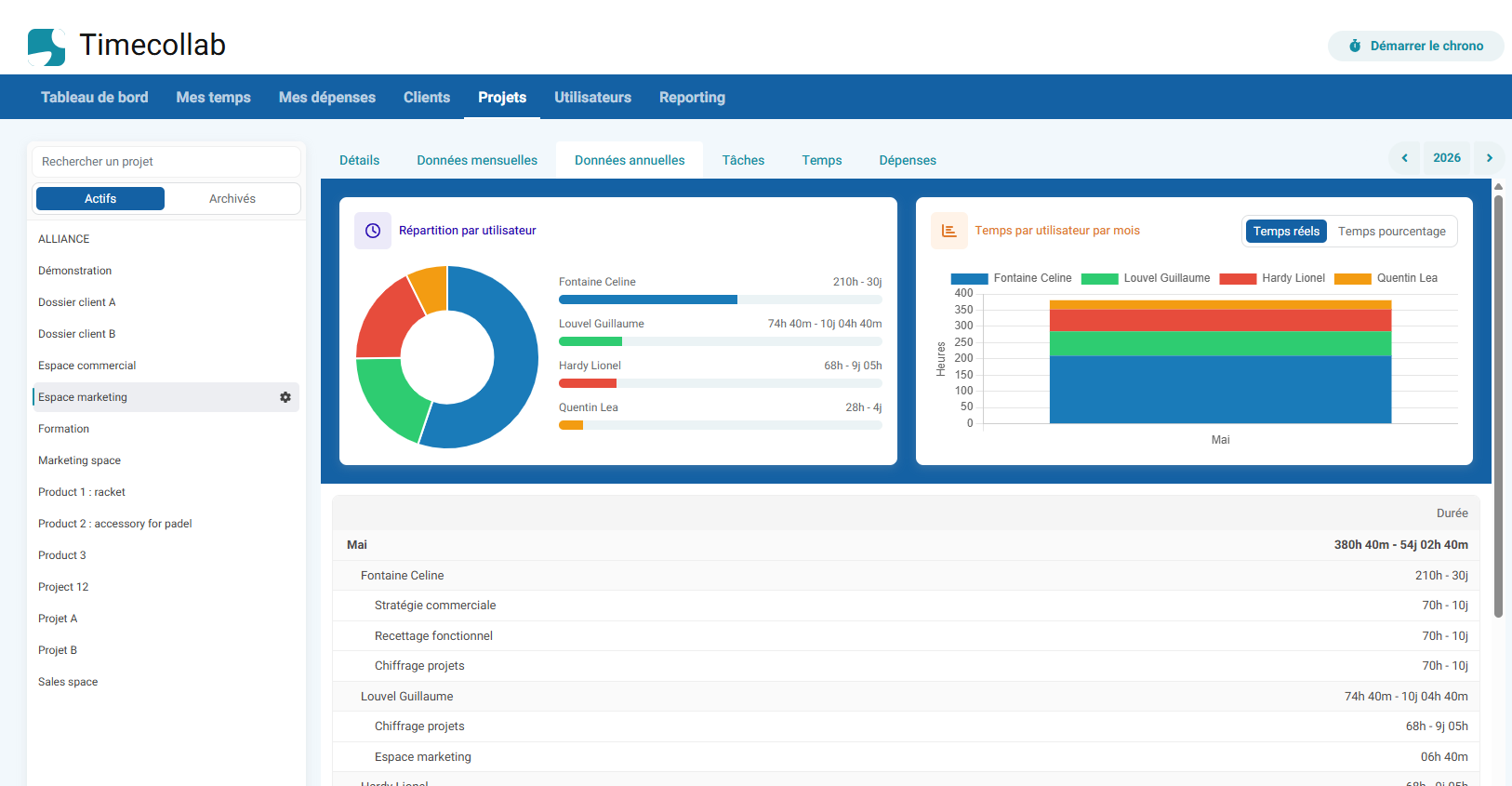
But that’s only part of the story. Thanks to TimeCollab, Acollab’s integrated time tracking module, teams can take project estimation to the next level.
Estimate, track... and learn from every project
With Acollab, every project can be broken down into detailed tasks, each with an estimated duration defined before work begins.
Using TimeCollab, teams can then:
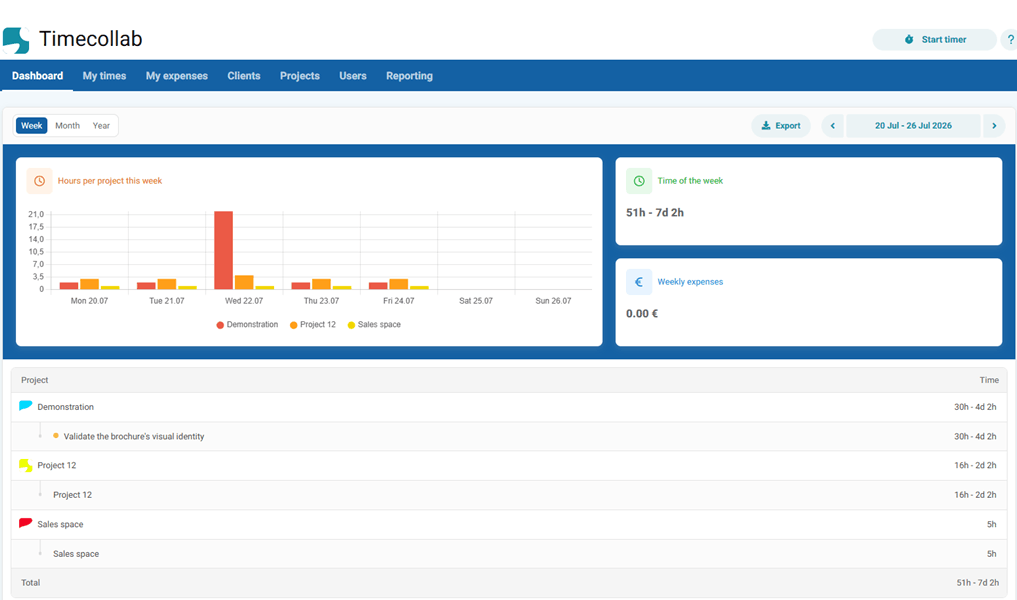
- Record the actual time spent on each task
- Track time by project, user, or activity
- Compare estimated versus actual time
This comparison is essential for continuous improvement while also creating a valuable project history.
It allows project managers to clearly identify whether a task was:
- Underestimated
- Overestimated
- Accurately estimated
More importantly, it helps them understand why.
A continuous improvement cycle
One of Acollab’s greatest strengths is its ability to create a continuous learning process:
- Estimate your tasks before the project starts.
- Track actual working time using TimeCollab.
- Analyze the differences between estimated and actual time.
- Improve your estimates for future projects.
Instead of relying on intuition, your estimates become increasingly data-driven.
Over time, teams become more accurate, more reliable, and more confident when committing to deadlines.
Conclusion
Accurately estimating a project is not just about choosing the right estimation method—it’s also about using the right tools.
By combining structured task management with precise time tracking through solutions like Acollab and TimeCollab, organizations can significantly improve the reliability of their project estimates.
The result is better planning, improved resource allocation, greater team confidence, and more successful projects.