
What is the difference between
project management and task management?
In the professional world, the terms project management and task management are often used as synonyms. However, they refer to very different realities. Understanding the difference between these two approaches is essential for better organization, improved efficiency, and choosing the right collaborative tools.
So, what exactly is project management? What does task management involve? How are they complementary rather than opposed? And how can teams combine them effectively in their daily work?
Definition of task management
Task management consists of organizing, planning, and tracking specific actions to be completed. A task generally corresponds to a concrete, identifiable, and measurable action.
Examples of tasks:
- Writing a document
- Responding to a client
- Updating a file
- Preparing a meeting
- Approving an invoice
Each task usually includes:
- A title
- A responsible person
- A deadline
- Sometimes a priority level or status
Task management is therefore execution-focused. It answers the question: What do I need to do, and when?

What is task management used for?
Task management is essential for:
- Organizing daily work
- Avoiding forgotten actions
- Prioritizing activities
- Visualizing workload
- Tracking operational progress
It is particularly useful at an individual level or for teams that need to coordinate many small actions.
However, when used alone, it quickly shows its limitations.
Definition of project management
Project management is a broader approach. It aims to plan, organize, lead, and coordinate all actions necessary to achieve a specific objective within a defined framework.
A project is characterized by:
- A clear objective
- A defined scope
- Deadlines
- Resources
- Constraints
- Stakeholders
Examples of projects:
- Launching a new product
- Developing software
- Organizing an event
- Deploying a new tool
- Running a communication campaign
Project management answers a broader question: How do we achieve a collective objective within a given framework?

Key components of project management
Project management is not limited to a list of tasks. It includes:
- Defining objectives
- Overall planning
- Role allocation
- Deadline monitoring
- Risk management
- Communication between stakeholders
- Results evaluation
Tasks are part of a project, but they represent only one element among many.
Project management vs. task management: fundamental differences
A difference in scale
The main difference lies in their level of granularity.
Task management focuses on individual actions.
Project management focuses on the overall vision.
You can manage tasks without a project, but you cannot manage a project without tasks.
A difference in objective
Task management aims at efficient execution.
Project management aims at achieving a strategic objective.
A task may be completed perfectly without the overall project truly progressing if it is not aligned with project objectives.

A difference in timeframe
Tasks are often short-term and occasional.
Projects extend over a longer period, with phases, milestones, and deliverables.
A difference in coordination
Task management can be individual.
Project management is fundamentally collective.
It involves multiple people, sometimes multiple teams, and requires structured coordination.
Why are project management and task management often confused?
This confusion is common for several reasons:
- Many tools present themselves as project management tools while only offering task tracking
- Teams often start by listing tasks without formally defining a project
- In small organizations, the same person manages both tasks and projects
As a result, teams believe they are doing project management when they are primarily tracking tasks.

The limits of a task-only approach
Focusing exclusively on task management can lead to:
- Loss of overall vision
- Difficulty prioritizing
- Work overload
- Lack of coordination
- Projects progressing without clear direction
Without a structured project framework, teams risk doing a lot… without moving in the right direction.
The benefits of true project management
Implementing structured project management allows organizations to:
- Align teams around shared objectives
- Give meaning to tasks
- Better anticipate risks
- Monitor overall progress
- Make better decisions
Project management brings coherence, whereas task management primarily brings organization.

Project management and task management: complementary approaches
It is not about choosing between project management and task management. The two are inseparable.
An effective organization relies on:
- A clear project vision
- Breaking it down into concrete tasks
- Both global and operational monitoring
The role of digital tools in this complementarity
Digital tools play a key role in connecting project management and task management.
A good tool should allow teams to:
- Structure projects
- Create and track tasks
- Visualize progress
- Centralize documents
- Facilitate communication
It is this integrated vision that makes the difference.

Acollab: connecting project management and task management
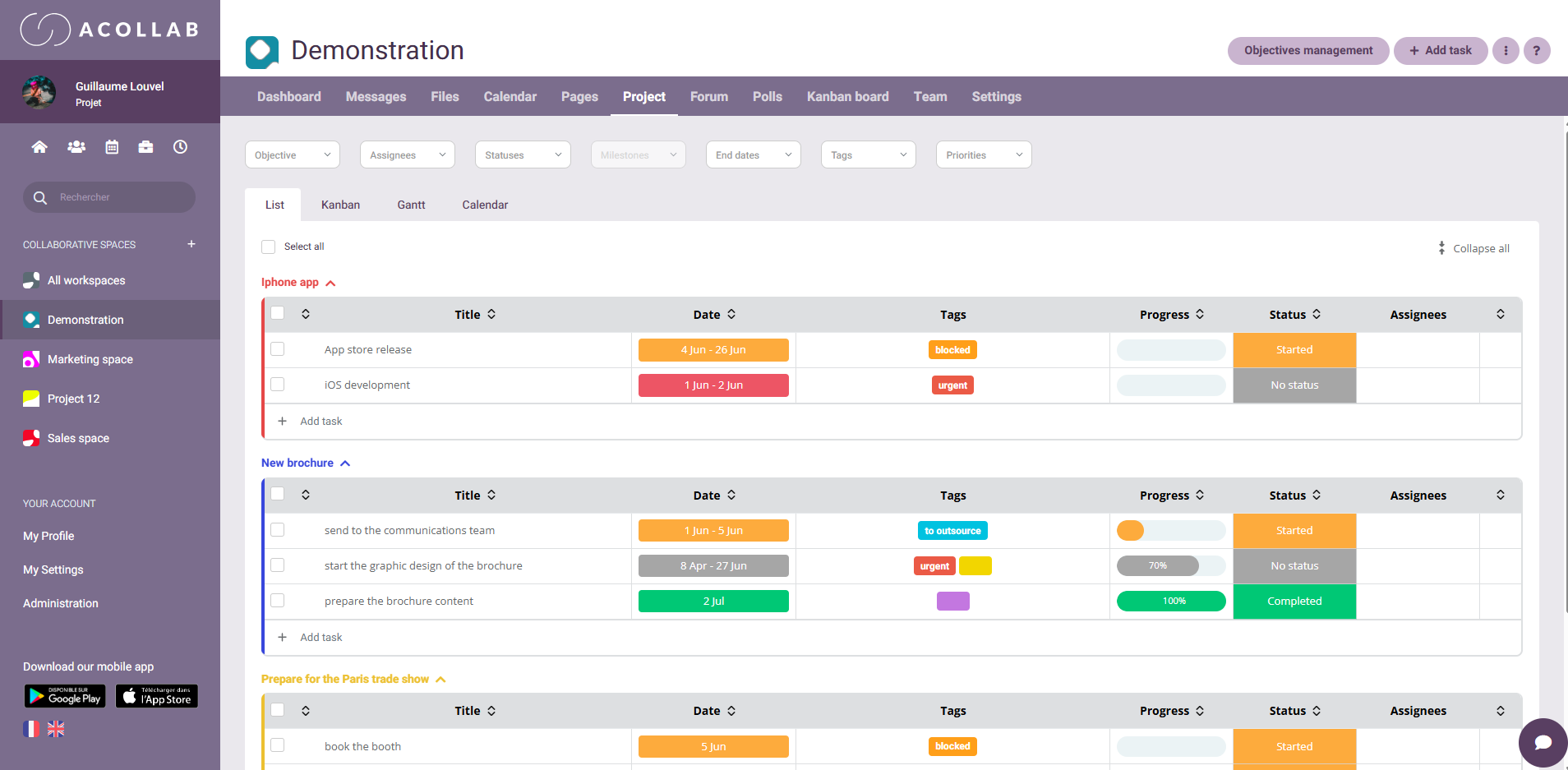
Within this framework, Acollab offers an approach that naturally connects project management and task management.
With Acollab, teams can:
- Organize work by project
- Create tasks directly linked to objectives
- Track both collective and individual progress
- Centralize discussions and documents
- Visualize priorities within a shared environment
The tool eliminates the opposition between tasks and projects by integrating them into a single collaborative workspace.
For which teams is this distinction crucial?
SMEs and startups
In agile structures, there is often a tendency to operate solely through tasks. Structuring projects helps better support growth.
Agencies and client-focused teams
Project management is essential for meeting deadlines, budgets, and client commitments while handling numerous daily tasks.
Public organizations and institutions
Projects often involve multiple stakeholders. A clear project vision prevents fragmentation and strengthens coordination.

How to move from task management to true project management
Some best practices include:
- Clarifying objectives before listing tasks
- Defining scope and priorities
- Identifying stakeholders
- Grouping tasks by project
- Regularly monitoring overall progress
- Using a collaborative tool adapted to team work
Conclusion
Task management and project management address different but complementary needs.
The first enables efficient daily execution.
The second ensures progress in the right direction.
Understanding their difference is essential to structure work, improve collaboration, and avoid organizational drift.
By combining a clear project vision with rigorous task management, teams gain efficiency, coherence, and peace of mind.
Collaborative tools like Acollab make it possible to bridge these two dimensions and sustainably anchor good collective work practices.