
Make the most of summer to rethink your company’s organization
For many companies, summer means a slowdown in business activity. Calendars are a little less busy, some projects are put on hold, and employees gradually take their holidays.
This period is often seen as a transition before the return to work in September.
Yet summer is also the perfect time to take a step back and review how your company is organized. September and October generally bring new projects, renewed business activity, and an acceleration in workload. So why wait until you are overwhelmed again before improving the way you work?
Making the most of the summer to take stock allows you to approach the new business season with more efficient processes, better-prepared teams, and tools that are better suited to your company’s needs.
Why is summer the best time to optimize your organization?
When a company is operating at full capacity, it can be difficult to question established habits.
Daily emergencies tend to take over: responding to customers, managing projects, organizing teams, handling requests…
As a result, everyone may be aware of certain inefficiencies, but they are rarely addressed.
Summer offers a different environment. With a sometimes slower pace, it becomes easier to:
- analyze your working methods
- identify time-consuming tasks
- review certain processes
- clean up outdated tools
- calmly prepare for changes and new priorities in September
A few adjustments made during this period can have a lasting impact on your company’s productivity.

Review your tools
Over the years, many companies accumulate digital solutions. One software tool for project management, another for sharing files, several messaging platforms, Excel spreadsheets, individual calendars, not to mention documents exchanged by email.
Each tool may meet a specific need. But in the end, information becomes scattered across different platforms.
Ask yourself a few simple questions:
- How many tools do you use every day?
- Is information easy to find?
- Do your teams know where to look for a document or piece of information?
- Are some features available in several different software tools?
Taking the time to review your digital tools can help you identify unnecessary duplication and simplify your employees’ daily workflows.
Analyze everyday time losses
Some tasks may seem insignificant when considered individually.
However, when they are repeated every day by several employees, they can represent a significant cost.
For example:
- searching for a document
- finding the latest version of a file
- entering information again when it is already available elsewhere
- asking for a project status update
chasing a colleague for approval
These small losses of time affect productivity and slow down the entire team. Summer is a good opportunity to identify these daily frustrations and think about more efficient solutions.

Centralize information
One of the main causes of organizational inefficiency is scattered information. A contract is saved on one computer. Meeting notes are sent by email. A procedure is stored on a shared drive. A decision is made in an instant messaging application.
When information is spread across several tools, every search takes longer. By contrast, centralizing documents, projects, and discussions in one place makes everyday work easier and significantly reduces wasted time.
A centralized workspace also makes it easier for employees to access the information they need, without having to remember which tool or communication channel was used.
Clean up your documents
Summer is also the perfect time to reorganize your document management.
Take this opportunity to:
- delete duplicate files
- archive old projects
- review your folder structure
- standardize file names
- check document
- access permissions
A well-structured document management system allows every employee to quickly find the information they need.
It also makes collaboration easier and reduces the risk of working with outdated or incorrect versions of documents.
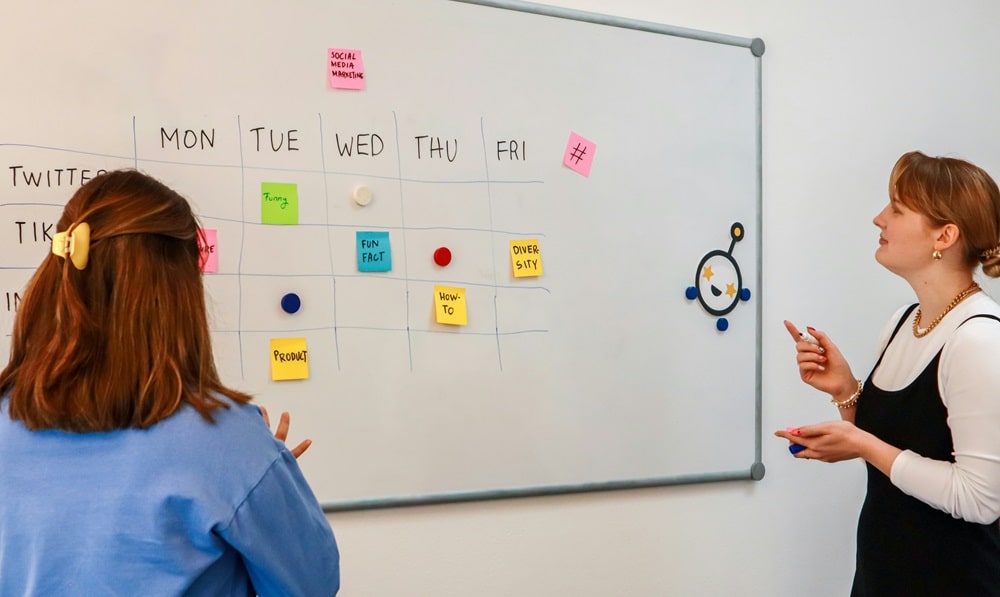
Reassess your project management
Are your current project management methods still suited to your business?
Many companies continue to manage their projects using Excel spreadsheets that have become difficult to maintain. Others use different tools depending on the team involved.
Use this period to analyze:
- how much visibility you have over your projects
- how tasks are distributed
- how deadlines are monitored
- how employees communicate with one another
Better project organization not only improves productivity, but also contributes to employee satisfaction.
When everyone knows what needs to be done, who is responsible, and when tasks are due, projects become easier to manage and teams can work with greater peace of mind.
Prepare for the new business season with clearer processes
The return to work in September is often marked by a rapid increase in activity. New projects, new customers, new priorities…
A clear organizational structure helps prevent teams from returning to the same difficulties as before. Before September, it can be useful to:
- update internal procedures
- document best practices
- prepare upcoming projects
- organize work folders
- define everyone’s responsibilities
A few hours spent preparing can save valuable time in the months that follow.

Involve your teams in the process
Employees are the primary users of your internal tools and processes. They know exactly what challenges they face on a daily basis.
Why not use the summer to gather their feedback?
A few simple questions can help identify areas for improvement:
- Which tasks take up the most time?
- Which information is difficult to find?
- Which tools are the least convenient to use?
- Which tasks or processes could be simplified?
Involving employees in the process also encourages them to adopt future changes.
When teams understand why a new tool or process is being introduced, they are more likely to use it effectively.

Simplify rather than add more tools
When facing an organizational problem, the temptation is often to add another application. However, adding more tools does not always solve the problem. On the contrary, it can make information even more fragmented.
The goal should be to simplify the way your company operates. Centralizing information, reducing duplication, and making collaboration easier are often much more effective than continuously adding new solutions.
How Acollab helps companies improve their organization
Reviewing your organization is easier when teams have access to a single working environment.
Acollab brings together the main features needed by small and medium-sized businesses in a single collaborative platform.
Teams can use Acollab to:
- centralize their documents with secure document management
- manage projects using List, Kanban, Gantt, Calendar, or Resources views
- share information without relying on multiple emails
- track tasks and deadlines
- collaborate around documents and projects
- quickly find information using the integrated search engine
- share a common calendar to better coordinate teams
By bringing information together in one centralized workspace, Acollab helps reduce wasted time and improve the organization of your business over the long term.