
Why a shared calendar has become essential for agencies ?
In an agency, time is a valuable resource. Between client meetings, production deadlines, approvals, team check-ins, and last-minute emergencies, daily organization can quickly become complex.
Whether it is a web, marketing, communications, design, or consulting agency, teams must constantly coordinate their efforts to remain responsive and meet deadlines. Yet many agencies still rely on individual calendars, spreadsheets, or informal exchanges to manage their schedules.
The result? Information becomes scattered, availability is unclear, and teams waste valuable time coordinating with one another.
This is precisely where a shared calendar becomes a strategic tool. When used effectively, it improves visibility, streamlines organization, and facilitates collaboration across the agency.
With Acollab, agencies can centralize their schedules and simplify the day-to-day management of projects and teams.

The organizational challenges agencies face
An agency rarely operates in a linear way. Teams constantly juggle multiple projects, multiple clients, and priorities that can change rapidly.
This dynamic environment requires seamless coordination.
Managing multiple projects without losing visibility
In an agency, it is common for employees to work simultaneously on:
- multiple clients
- multiple assignments
- various meetings
- urgent tasks
- approval stages
Without a clear overview of availability and deadlines, the risk of overload increases significantly.
The consequences quickly become apparent:
- meetings scheduled at the wrong time
- scheduling conflicts
- delays
- forgotten tasks
- uneven workload distribution
A shared calendar helps reduce these issues by providing a clear view of team activity.

Coordinating hybrid teams
Remote and hybrid work models have transformed the way agencies operate.
Today, team members may work remotely, from different offices, or while traveling.
In this context, it becomes essential to know:
- who is available
- who is working on which project
- which meetings are scheduled
- which deadlines are approaching
A shared planning facilitates coordination and reduces misunderstandings.
Preventing information silos
In many agencies, scheduling information is still shared through emails, instant messages, phone calls, or personal notes.
This fragmented approach makes day-to-day management much more difficult.
How much time do teams spend asking questions such as:
- “Who is available tomorrow?”
- “Has the client meeting been rescheduled?”
- “When does the deliverable need to be sent?”
- “Who is involved in this project?”
A shared calendar centralizes this information in a single space accessible to everyone.

The benefits of a shared calendar for agencies
A shared calendar does much more than display appointments. It becomes a genuine team management tool.
Better visibility for the entire team
One of the first advantages of a shared calendar is transparency.
Team members can easily view:
- meetings
- deadlines
- availability
- absences
- important events
This visibility significantly improves internal organization.
Teams save time and can anticipate their workload more effectively.

Smoother coordination
In an agency, many tasks depend on several stakeholders.
For example:
- a project manager is waiting for approval
- a designer is waiting for a brief
- a developer is waiting for client feedback
- a meeting requires multiple participants to be available
A shared calendar facilitates coordination by allowing everyone to understand the constraints and availability of other team members.
Reducing scheduling conflicts
Without centralized planning, scheduling conflicts become common:
- double bookings
- overlapping meetings
- forgotten availability updates
- overloaded employees
With a shared calendar, teams can anticipate constraints more effectively and distribute workloads more evenly.
An essential tool for improving productivity
Poor organization often generates invisible but significant losses of time.

Less time spent coordinating
In many agencies, teams spend a considerable part of their day:
- checking availability
- scheduling meetings
- searching for information
- following up with colleagues
A shared calendar significantly reduces these time-consuming micro-tasks.
Information becomes instantly accessible, making the agency’s overall operations more efficient.
Better priority management
When deadlines are clearly visible, teams can:
- organize their time more effectively
- anticipate busy periods
- avoid last-minute emergencies
This visibility also improves project management and reduces employees’ mental workload.

A more structured and stress-free work environment
Agencies often operate in demanding environments where pressure can be high.
A shared calendar helps:
- structure daily activities
- clarify priorities
- reduce forgotten tasks
- minimize stress related to organization
As a result, teams work in a more streamlined and reassuring environment.
Better client management
An agency’s internal organization has a direct impact on the quality of its client relationships.

Meeting deadlines more easily
Delays are often caused by:
- a lack of visibility
- poor coordination
- missed deadlines
With a shared calendar, teams can more effectively track:
- delivery dates
- approvals
- client meetings
- important milestones
This organization improves responsiveness and reinforces the agency’s professionalism.
Simplifying client interactions
Agencies constantly need to organize meetings, progress reviews, approvals, and presentations.
A shared calendar simplifies this process and helps teams coordinate client interactions more effectively.
Acollab : a shared calendar designed for teams
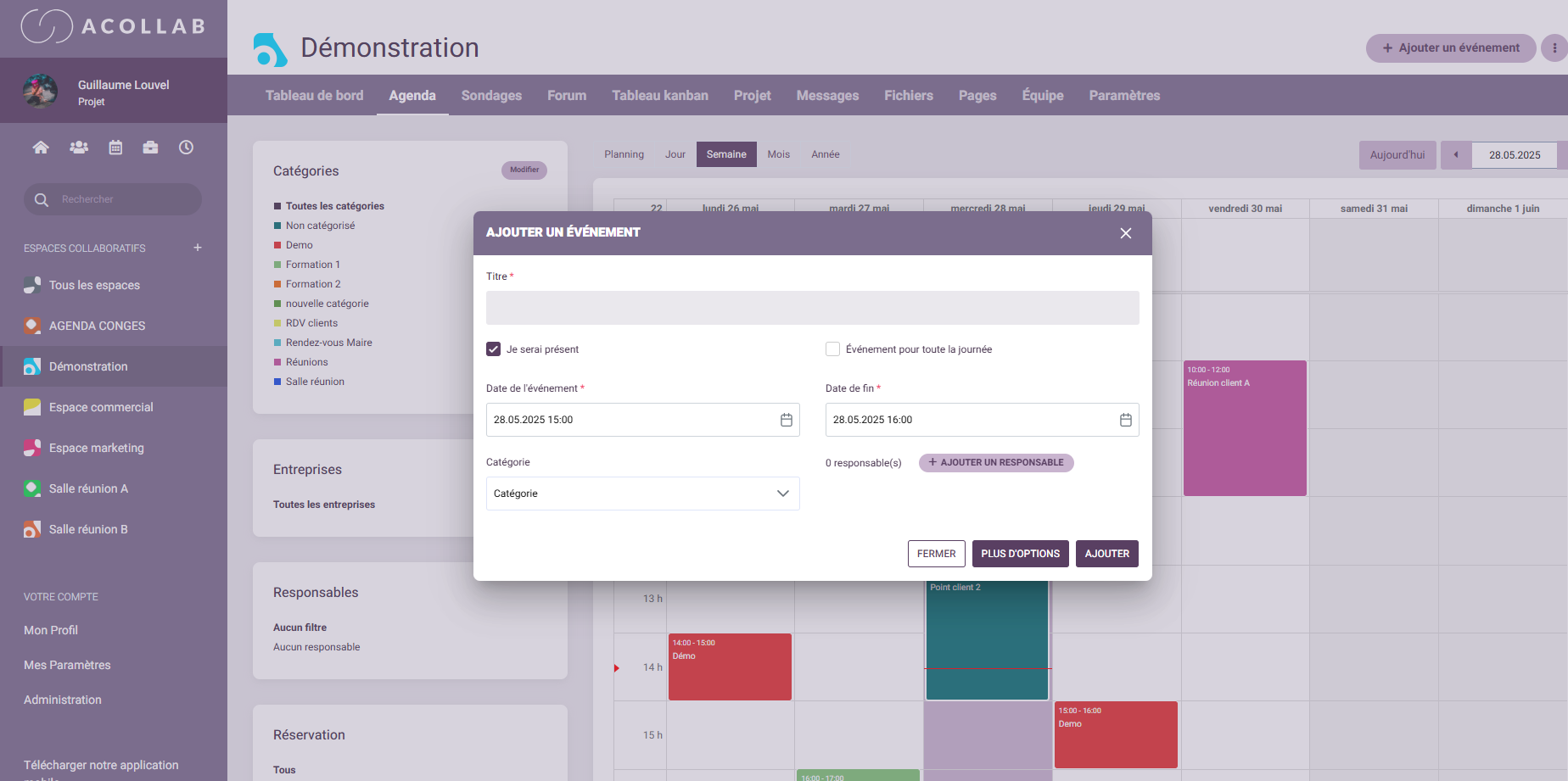
Acollab provides a collaborative workspace that enables agencies to centralize their organization. The goal is simple: give teams better visibility into their activities and facilitate day-to-day coordination.
Centralizing schedules and projects
With Acollab, teams can access in a single workspace calendars, projects, documents and discussions.
This centralization significantly reduces information silos.
Making collaboration easier
Team members can:
- share their availability
- track deadlines
- organize meetings
- coordinate projects more efficiently
This smoother collaboration improves productivity and reduces wasted time.
A solution tailored to agencies
Agencies need tools that can keep up with their pace and flexibility.
Acollab is designed around three key principles:
- simplicity
- collaboration
- team organization

Structuring your agency to collaborate more effectively
As an agency grows, organization quickly becomes a strategic issue.
Informal methods may work in the early stages, but they soon reach their limits when:
- projects multiply
- teams expand
- the number of clients increases
A shared calendar helps structure day-to-day operations without adding complexity to the agency’s workflow.
It improves:
- visibility
- coordination
- priority management
- project tracking
- collaboration between teams
In an environment where responsiveness and organization have become essential, a shared calendar is no longer just a convenience—it is a genuine driver of collective efficiency.
With Acollab, agencies benefit from a simple and collaborative French solution that centralizes organization and streamlines teamwork.